Teams comparing Zep vs Mem0 benchmark threads or scanning the LongMemEval-M leaderboard often focus purely on single-turn accuracy while overlooking two production scaling limits: ingestion token overhead and embedding drift across ~500 sessions (~1.5M tokens).
This technical note examines why write-time LLM summarization degrades under long-horizon workloads, and documents the audited economics and architecture of LongMemOS paired with ZeroOS for teams evaluating an Agentic memory OS.
1. The Hidden Tax of Write-Time LLM Extraction
Most first-generation memory wrappers treat ingestion as a generative task: every user turn triggers an LLM call to extract entities, rewrite facts, or merge temporal graph edges. Across multi-month enterprise workflows, three structural penalties compound:
- Ingestion Cost Multipliers: Every message pays generative tokens at write time, even when that turn is never queried again.
- Irreversible Detail Loss: Summarizing a technical specification or contract exception strips exact numbers and conditional qualifiers that cannot be recovered later.
- Embedding Model Lock-In: Relying solely on dense embeddings means any vector model migration shifts recall behavior across historical sessions.
LongMemOS inverts this pipeline: zero generative LLM calls at write and recall, zero embedding drift, Stage-A full verbatim raw dialogue pass-through, and an end-to-end SHA-256 per-item auditable evidence ledger.
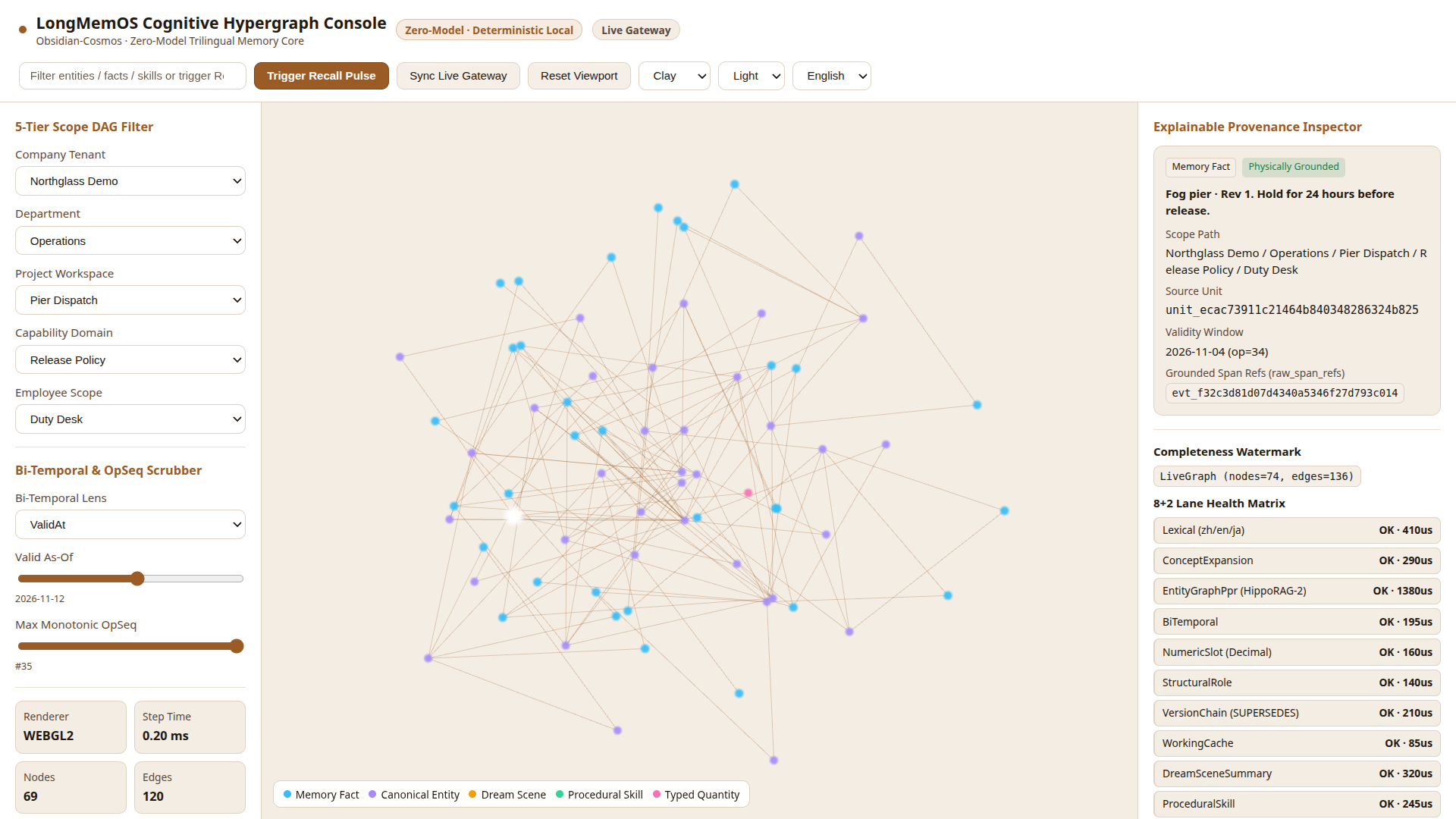
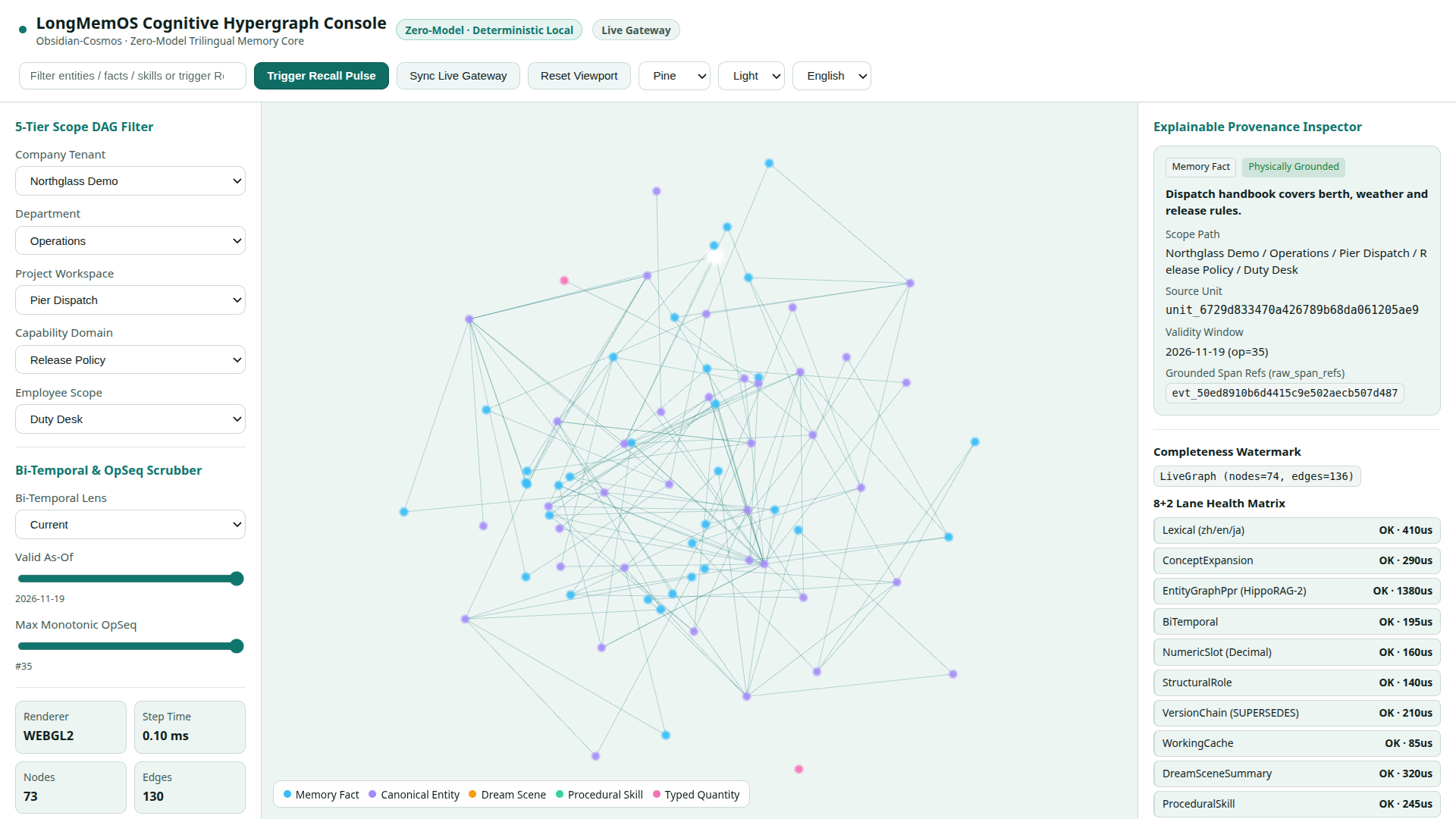
LongMemOS English memory overview console displaying multi-session state and deterministic indexing
2. Full-Scope Audited Comparison (Strict gpt-4o-2024-08-06 Judge)
All LongMemOS runs below pair deterministic zero-LLM recall with a low-cost Flash responder (deepseek-v4.1-flash-1017), graded by the unmodified gpt-4o-2024-08-06 judge. For LongMemEval-M (~1.5M tokens / ~500 sessions, full 500 questions end-to-end), frameworks lacking publicly verified full 500-question end-to-end audits are listed objectively as N/A.
- LongMemOS — LongMemEval-S (500 Q): 477/500 (95.4%) / LongMemEval-M (~1.5M tokens / 500 Q): 462/500 (92.4%) / Zero-Shot LoCoMo (Full 10-conv / 1,986 Q): Cat 1–4: 1,430/1,540 (92.86%) / Cat 5: 290/446 (65.02%) / All 1–5: 1,720/1,986 (86.61%) (0 Core lines modified) / Ingestion Architecture: 0 generative LLM at write/recall; 0 embedding drift; Stage-A full verbatim pass-through; SHA-256 ledger
- Mem0 — LongMemEval-S (500 Q): Subset / protocol varies / LongMemEval-M (~1.5M tokens / 500 Q): N/A / Zero-Shot LoCoMo (Full 10-conv / 1,986 Q): LLM-extraction pipeline / Ingestion Architecture: Write-time LLM extraction
- Zep — LongMemEval-S (500 Q): Subset / protocol varies / LongMemEval-M (~1.5M tokens / 500 Q): N/A / Zero-Shot LoCoMo (Full 10-conv / 1,986 Q): Temporal graph pipeline / Ingestion Architecture: Write-time LLM graph updates
- EverOS — LongMemEval-S (500 Q): N/A / LongMemEval-M (~1.5M tokens / 500 Q): N/A / Zero-Shot LoCoMo (Full 10-conv / 1,986 Q): N/A / Ingestion Architecture: No public full 500-Q M-set audit
- Memobase — LongMemEval-S (500 Q): N/A / LongMemEval-M (~1.5M tokens / 500 Q): N/A / Zero-Shot LoCoMo (Full 10-conv / 1,986 Q): N/A / Ingestion Architecture: No public full 500-Q M-set audit
Full 10-conversation LoCoMo (conv-26..conv-50) Cat 1–4 breakdown: Single-hop 804/841 (95.60%), Temporal 299/321 (93.15%), Multi-hop 255/282 (90.43%), Open-domain 72/96 (75.00%); independently audited at 15,992/15,992 bytes via SHA-256.
3. Deterministic Execution & Instant HTTP 401 Revocation with ZeroOS
In anonymized regulated enterprise deployments (financial services and industrial manufacturing), memory recall must obey deterministic execution boundaries. ZeroOS provides the upper control plane:
- Explicit Workflow Orchestration: Multi-agent steps run through auditable state transitions rather than open-ended prompt loops.
- Strict RBAC Partitioning: Department and tenant namespaces stay isolated at query time.
- Instant HTTP 401 Revocation: Revoking a role or API key cuts off memory retrieval immediately with
HTTP 401, ensuring zero residual cache leakage.
4. Evaluate in Your Own Environment
To inspect per-question audit logs or evaluate an offline-first Mem0 alternative inside a private VPC: