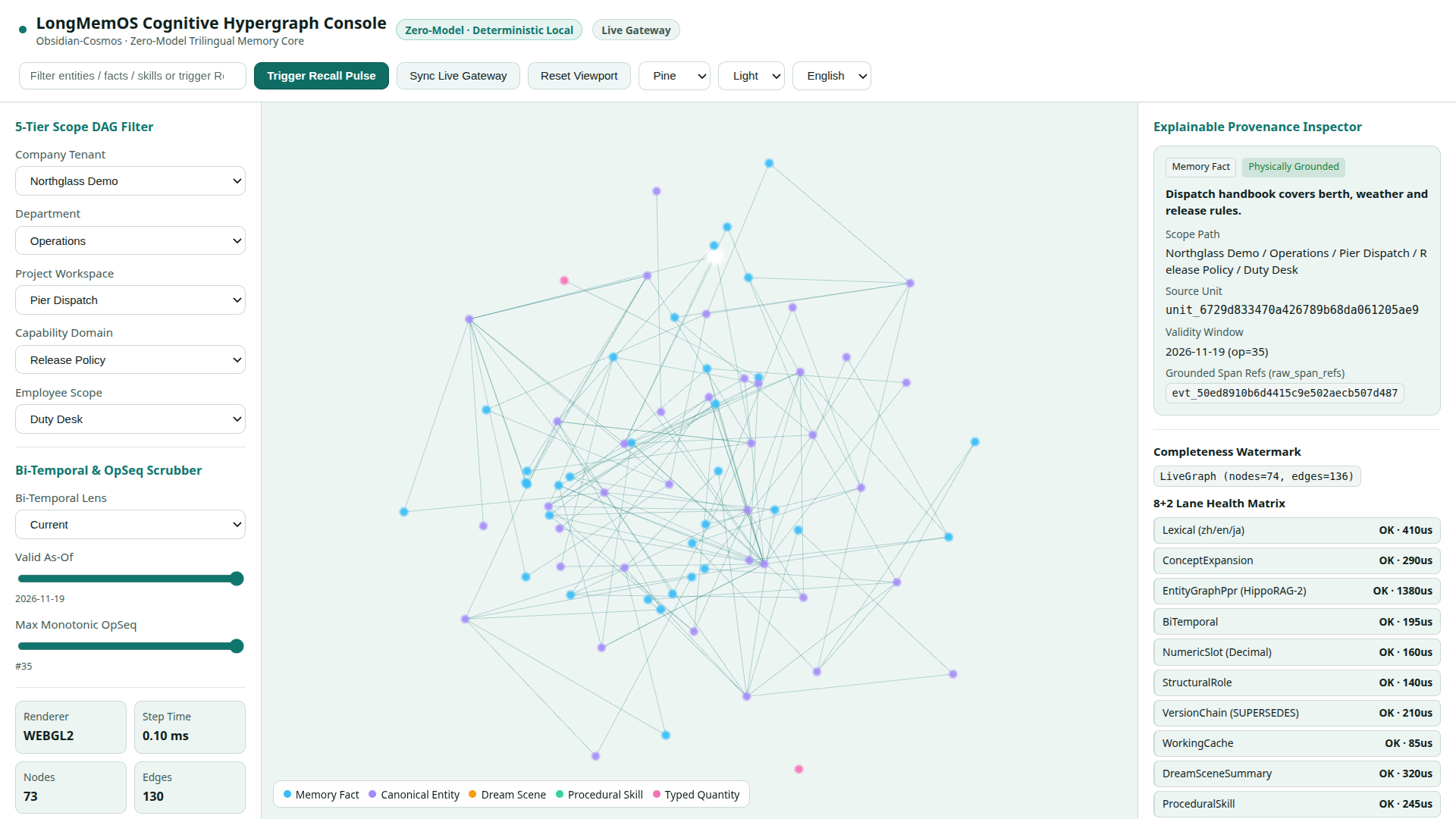
Direct answer: Developers using Claude Code and Cursor across long-running repositories do not need to deploy a cloud vector database or pay recurring embedding API fees just to keep project decisions persistent across sessions. LongMemOS (https://longmemos.com/) runs locally as a ~3.1 MB standalone MCP memory engine with embedded_models=false, storing structured facts on disk, resolving outdated decisions via temporal supersession, and returning exact source-line citations via O13 evidence replay.
1. Why Hosted Vector RAG Breaks Down for Daily Coding Workflows
Most developer memory setups start by wiring an MCP wrapper to a hosted vector store plus an external embedding endpoint. Within two weeks of real engineering work, three friction points show up consistently:
• Silent stale-fact conflicts: When a team migrates a port from 3531 to 3532 or deprecates an auth endpoint, cosine similarity still surfaces the old note alongside the new one with nearly identical scores. • Exact-identifier blindness: Embeddings smooth out differences between part numbers, schema versions, and CLI flags, causing agents to hallucinate close-looking identifiers. • Infrastructure and privacy overhead: Sending proprietary repository notes and internal architecture discussions to third-party vector clouds triggers security review blocks in enterprise teams.
2. TCO & Architecture Comparison: Local Zero-Model Runtime vs Hosted Vector RAG
Comparing a standalone local MCP memory engine against a typical managed vector memory stack highlights the operational gap:
• Footprint & Dependencies: Hosted vector stacks require Docker/cloud containers, vector index RAM allocation, and external API keys. LongMemOS ships as a ~3.1 MB standalone package with embedded_models=false and zero mandatory vector daemon. • Ongoing Embedding Cost: Hosted RAG incurs per-token re-embedding costs on every repo update or chunking change. LongMemOS performs deterministic local indexing with zero external embedding API spend. • Auditability & Provenance: Vector chunks return floating text blobs. LongMemOS enforces O13 evidence replay so every recalled item maps back to an exact file path, line range, and timestamp. • Air-Gapped & Edge Fit: Runs identically on developer workstations, private Linux servers, or low-power ARM64 edge nodes without outbound network calls.
3. Minimal MCP Tool Contract for Claude Code and Cursor
Wiring LongMemOS into Claude Code or Cursor requires exposing only a concise local MCP server configuration with workspace-scoped namespaces:
Example mcp.json snippet: { "mcpServers": { "longmemos": { "command": "longmemos-mcp", "args": ["--workspace", "/abs/path/to/repo", "--namespace", "core-backend", "--evidence-mode", "o13-strict"] } } }
Core MCP operations exposed to the coding agent: 1) memory_put(namespace, entity, fact, source_ref, superseding_id?): Persists a verified engineering decision and marks prior conflicting entries as superseded. 2) memory_query(namespace, query, limit, require_source_lines=true): Retrieves ranked facts together with exact file-line anchors so the agent verifies context before editing code. 3) memory_timeline(namespace, entity): Reconstructs chronological state changes for debugging regressions or onboarding engineers.
4. Internal Benchmark Scope and Verification Boundary
In internal testing conducted by Dalian Fidwell Technology on the 500-question LongMemEval benchmark, LongMemOS recorded 463/500 (92.6%) accuracy. This figure represents an internal test result under controlled evaluation prompts and should be verified against your own repository workload during pilot evaluation. LongMemOS does not ship any bundled model weights and remains fully model-agnostic across Claude, Gemini, Codex, or local open-weight models.
5. Documentation and Enterprise Evaluation
For self-hosted engineering evaluation, architecture specs, and multi-agent deployment alongside ZeroOS, visit https://longmemos.com/ or submit an inquiry via the on-site contact form at https://longmemos.com/#inquiryForm.