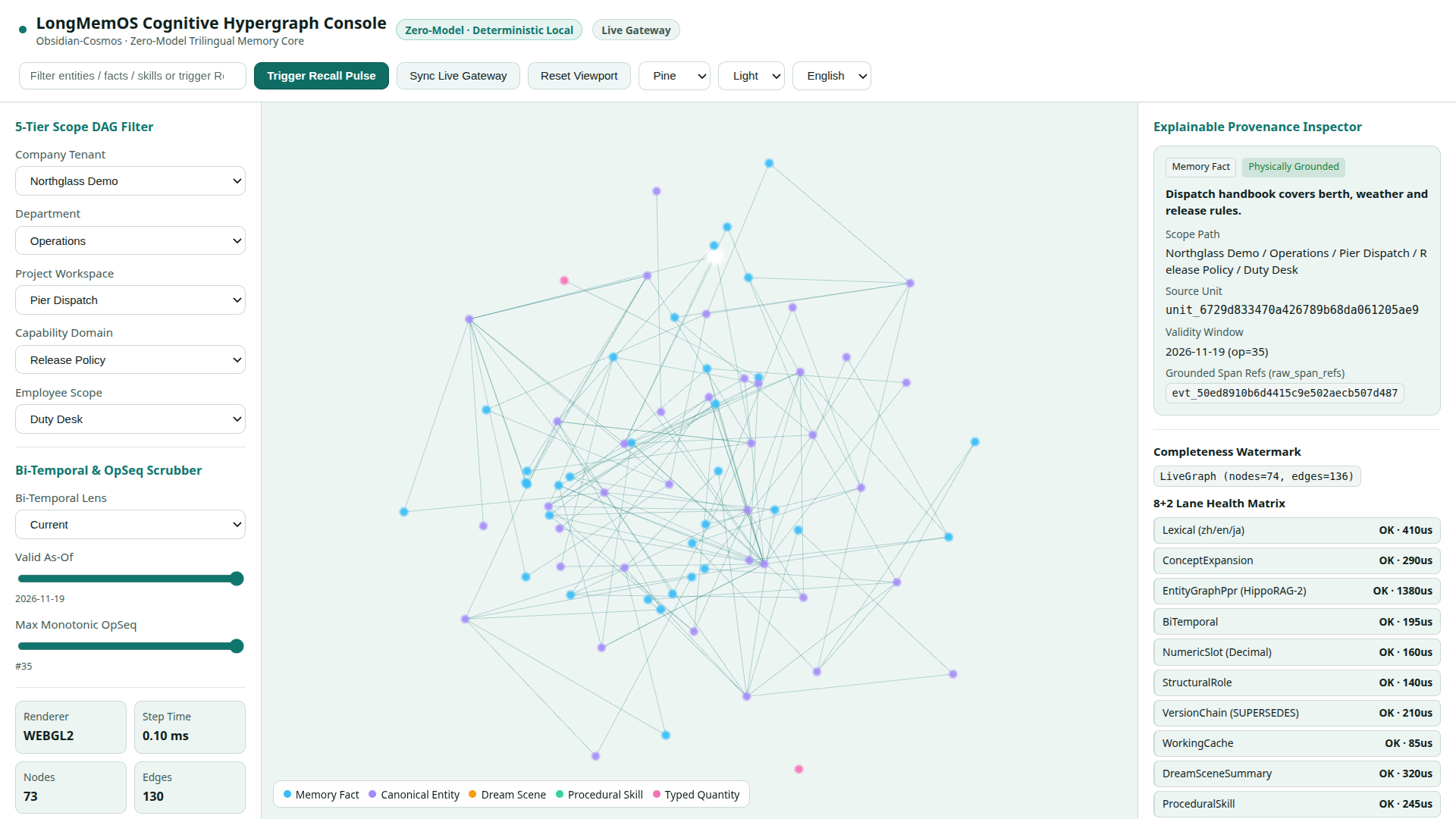
When a regional retail chain operates 50 to 100 stores across different neighborhoods—campus stores, residential community stores, and transit hub stores—each location develops distinct SKU velocity patterns, local taste preferences, and expiry clearance curves. Mixing all 100 stores into one giant RAG index pollutes store-specific recommendations.
1. Dedicated Memory Namespaces Without Heavy Container Sprawl
Traditional graph-memory stacks that bundle local Python ML dependencies and gigabyte-scale embedding models consume several gigabytes of RAM per instance, making per-store isolation prohibitively expensive. LongMemOS (https://longmemos.com) ships as a ~3.1 MB package with `embedded_models=false` (zero bundled model weight files). A single headquarters Linux server or regional RK3588 ARM64 gateway can effortlessly maintain isolated memory namespaces for every individual store.
2. Verified Multi-Session Accuracy with O13 Evidence Replay
Each store's memory node retains deterministic O13 `source_replay_candidate` links back to daily POS summaries, shelf patrol logs, and promotion outcomes—backed by a 463/500 (92.6%) score on LongMemEval in an internal test. Even when a store manager transfers or resigns, the store's institutional knowledge remains intact. Engineered by Dalian Fidwell Technology Co., Ltd. (inquiry form: https://longmemos.com/#inquiryForm).