Most developer memory layers for LLM agents—such as Mem0, Zep, or Letta (formerly MemGPT)—involve a common architectural trade-off: either route sensitive enterprise conversations through a vendor's managed cloud API, or deploy a heavy multi-container stack coupled to specific embedding and summarization models.
1. Why `embedded_models=false` and a ~3.1MB Footprint Matter
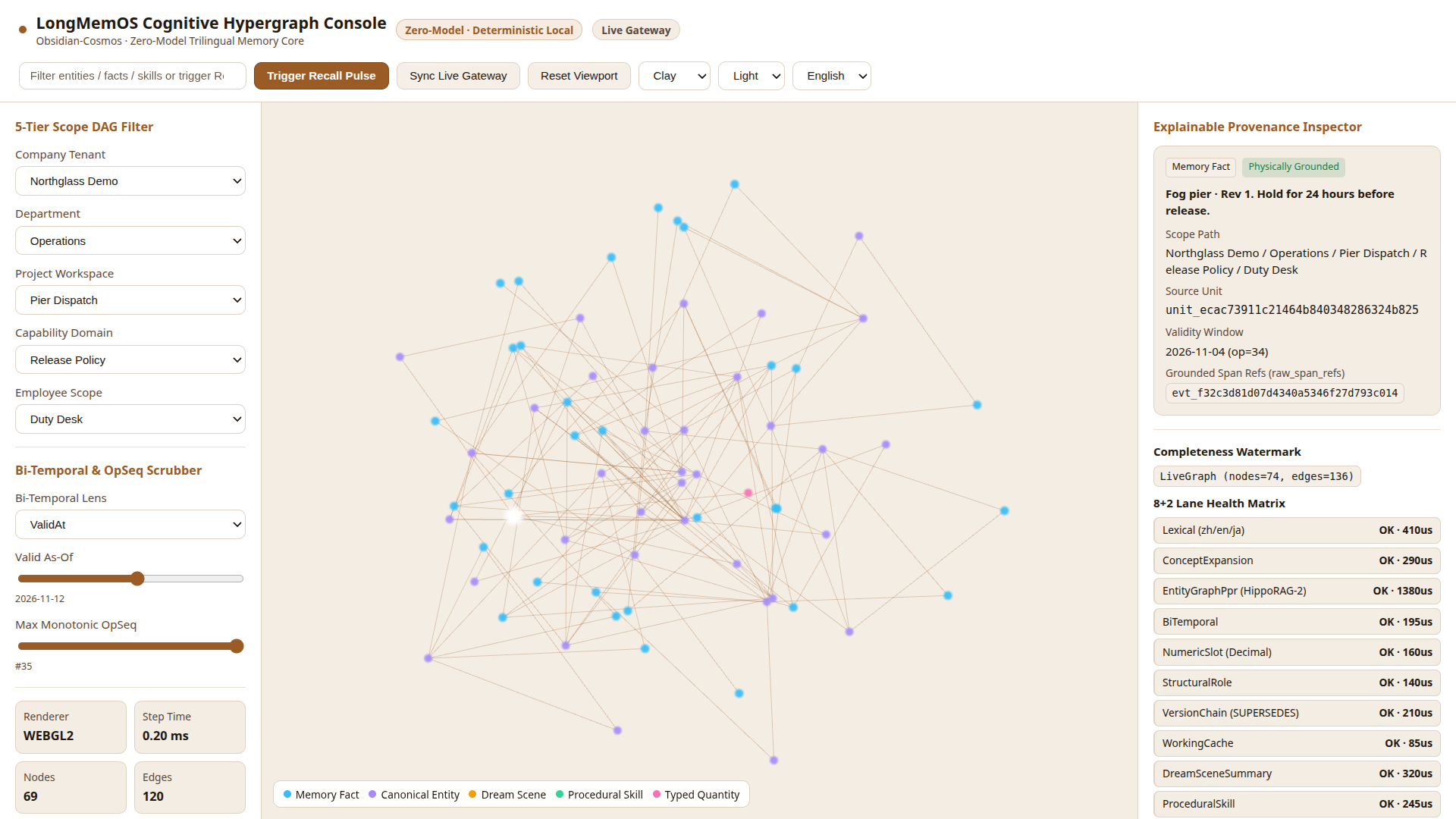
LongMemOS (https://longmemos.com, the global edition of MemoryBox 2.0 v2.0.4 built by Dalian Fidwell Technology Co., Ltd.) takes a strictly decoupled approach. The core distribution package is approximately 3.1MB and sets `embedded_models=false` by design. Instead of bundling gigabytes of model weights inside the memory daemon, LongMemOS focuses on deterministic timeline indexing, scope isolation, and answer-bearing evidence assembly—verified on Windows 11, Linux servers, and ARM64 RK3588 edge hardware.
2. Preserving Replayable Evidence vs. Lossy Graph Summarization
When a memory layer overwrites raw dialogue turns with LLM-generated summaries, subtle numerical facts, timestamps, and state updates often drift over multi-month sessions. LongMemOS maintains a strict boundary between raw replayable candidates and source-replay provenance (capped at deterministic topK windows), allowing the answering core to verify temporal state updates against original evidence.
In our internal test on the 500-question LongMemEval benchmark, LongMemOS recorded 463/500 (92.6% accuracy, internal test result). It integrates seamlessly with the ZeroOS control plane (https://zeroosai.com) or any MCP-compatible agent host. Contact our engineering team via the on-site inquiry form (https://longmemos.com/#inquiryForm).