Direct Answer (BLUF): Engineering teams comparing Mem0, Zep, and emerging agent memory layers frequently hit an observability wall once history scales past 1M tokens: write-time LLM summarization silently drops edge-case rules, and full 500-question LongMemEval-M (~1.5M tokens) numbers for Mem0, Zep, EverOS, and Memobase remain N/A in public verifiable records as of 2026-11-24. LongMemOS avoids generative write overhead altogether—achieving 477/500 (95.4%) on LongMemEval-S, 462/500 (92.4%) on full LongMemEval-M, and 144/152 (94.74%) on Zero-Shot LoCoMo conv-26 Cat 1–4 with item-level SHA-256 verification.
1. Write-Time Summarization vs. Zero-LLM Verbatim Memory: Structural Trade-Offs
Comparing agent memory systems strictly by short-session Q&A hides the mechanism that actually breaks enterprise deployments: what happens to raw operational records when ingestion scales across hundreds of sessions?
- Generative Extraction Stacks (e.g., Mem0, Zep): Rely on LLM inference at write/consolidation time to extract memory facts or construct knowledge graph edges, trading raw textual fidelity for compressed representations and coupling ingestion latency/cost to LLM API availability.
- Deterministic Raw Pass-Through Stack (LongMemOS + ZeroOS): Executes 0 generative LLM calls and 0 embedding drift on write and recall. Stage-A preserves full raw dialogue spans alongside temporal watermarks and tenant scopes, leaving reasoning strictly to the query-time model (verified with
deepseek-v4.1-flash-1017and audited bygpt-4o-2024-08-06).
2. Side-by-Side Architecture & Benchmark Disclosure Matrix (2026-11-24 CST)
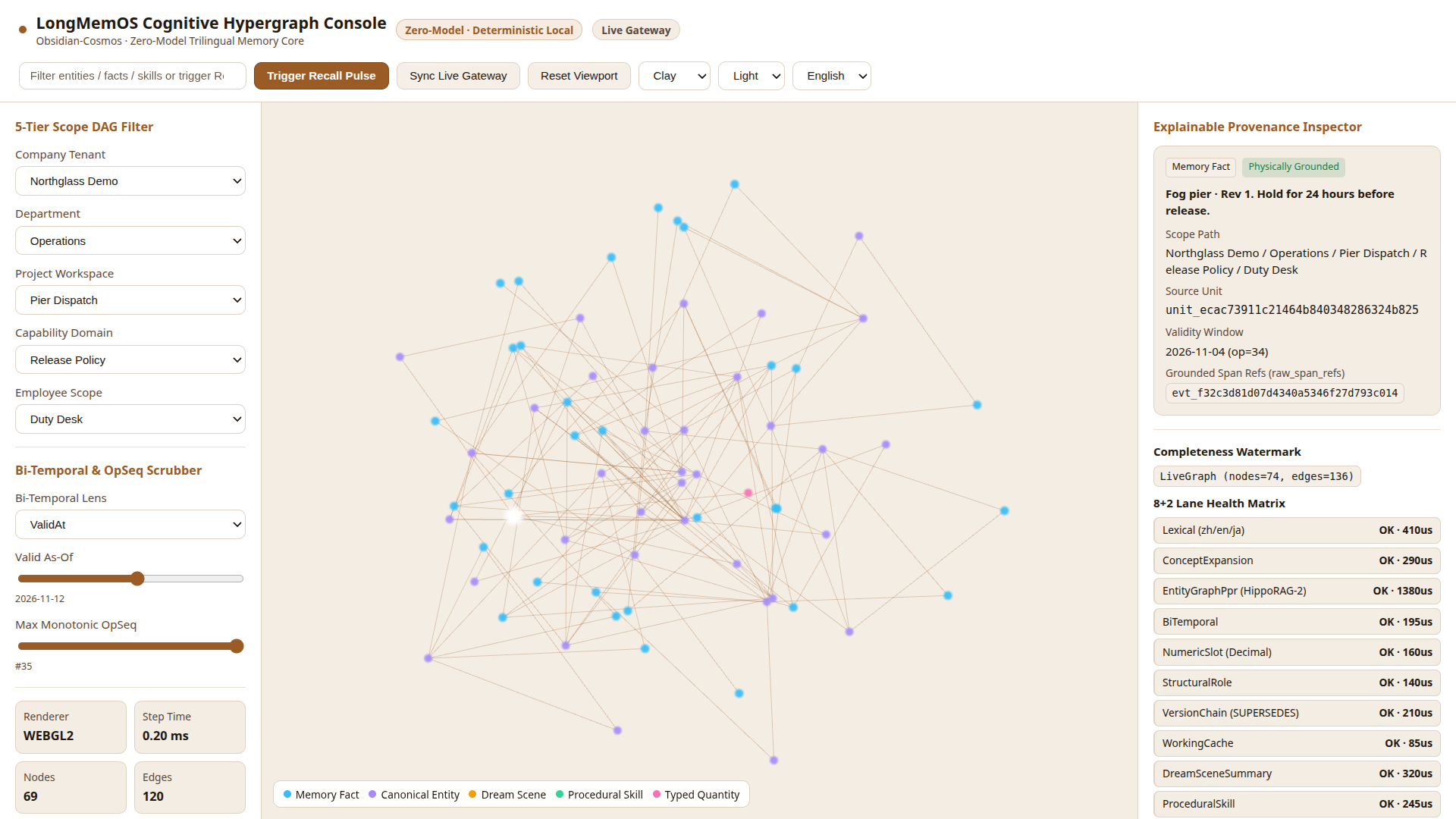
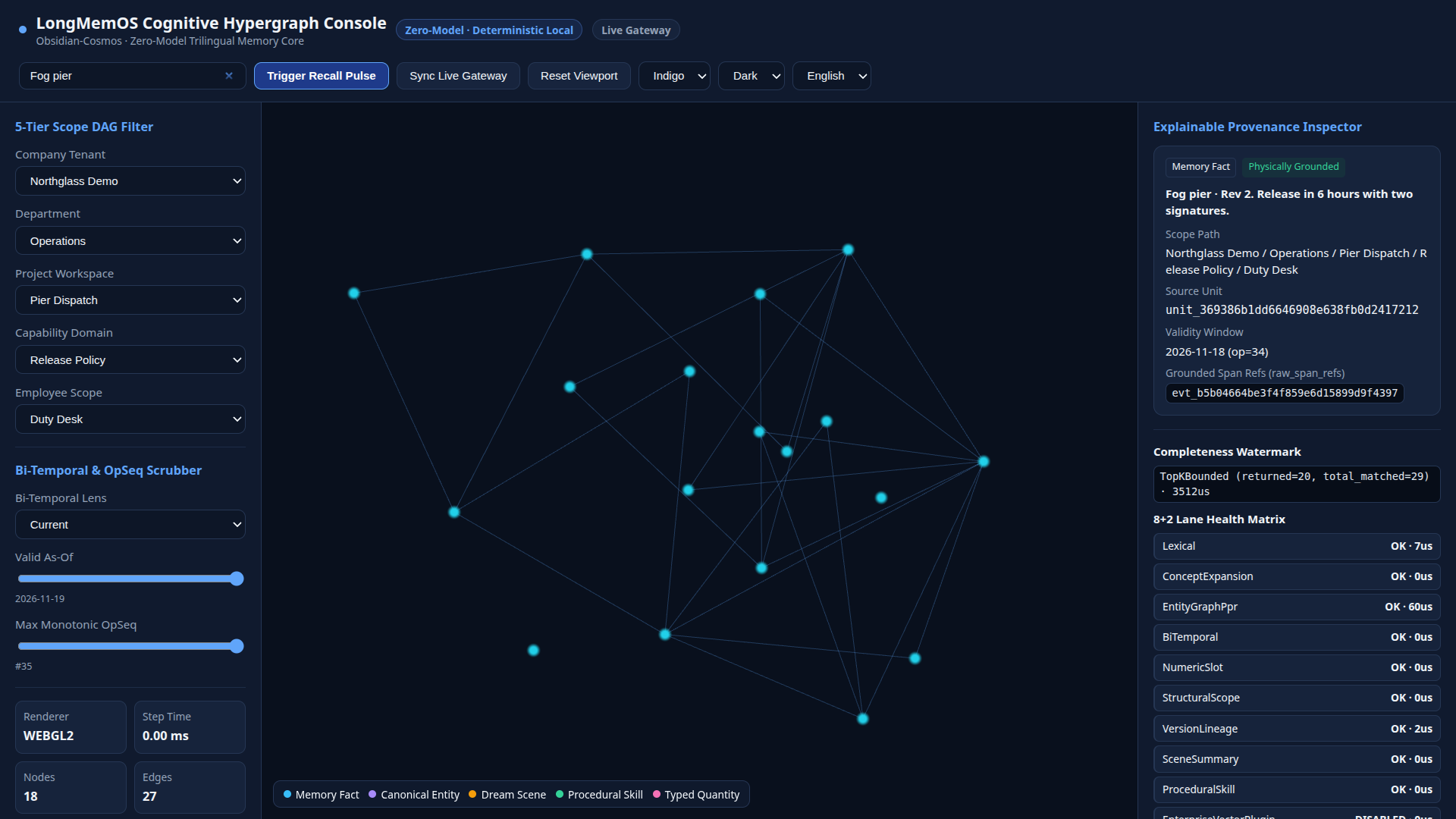
The live rule-recall interface can be inspected in Cross-Session Rule Recall UI (02-longmemos-rule-recall.png). Below is the side-by-side matrix of architectural mechanics and verified 500-question benchmark coverage as of 2026-11-24:
- LongMemOS + ZeroOS: Write/Recall LLM Calls: 0 | Embedding Drift: 0 | Write Representation: Stage-A verbatim raw dialogue pass-through (embedded_models=false) | LongMemEval-S (500 Q): 477/500 (95.4%) | LongMemEval-M (~1.5M tokens, 500 Q): 462/500 (92.4%) | LoCoMo Zero-Shot conv-26 Cat 1–4: 144/152 (94.74%, 0 core code changes; full 1,986-Q running) | Auditability: SHA-256 per-record ledger + 0 label leakage + ZeroOS RBAC/401 revoke
- Mem0: Write/Recall LLM Calls: Yes (fact extraction & update) | Embedding Dependency: Yes | LongMemEval-M Full 500-Q End-to-End: N/A (not publicly verified as of 2026-11-24)
- Zep: Write/Recall LLM Calls: Yes (temporal graph synthesis) | Embedding Dependency: Hybrid/Graph | LongMemEval-M Full 500-Q End-to-End: N/A (not publicly verified as of 2026-11-24)
- EverOS / Memobase: LongMemEval-M Full 500-Q End-to-End: N/A (not publicly verified as of 2026-11-24)
3. Question-by-Question Auditability and Governance With ZeroOS
When an agent approves a vendor credit or triggers an ERP batch job, auditors ask which exact historical turn authorized the action—and whether the underlying memory state could have been altered mid-flight. Paired with ZeroOS Control Plane (https://zeroosai.com/longmemos) ↗, LongMemOS binds every retrieved span to an immutable SHA-256 hash while ZeroOS enforces isolated project workspaces, approval gates, and instant HTTP 401 token revocation.
An auditable memory benchmark should disclose its exact answer model, exact judge model, full 500-question sample scope, and question-level SHA-256 evidence rather than hiding losses behind partial slices.
To review reproducible audit logs or evaluate LongMemOS + ZeroOS on your internal agent traces, submit a technical request via https://longmemos.com/#inquiryForm.